Economic
Lower input dependence
- Reduces fertilizer and pesticide purchases
- Improves net farm income potential
- Limits exposure to input-price volatility
- Helps smallholders keep more value on-farm
100% reported lower expenses
Brand consulting presentation for SPK founders
SPK has a strong sustainability story. The next challenge is not just awareness — it is reducing transition risk, strengthening trust, and integrating SPK into the agricultural value chain.
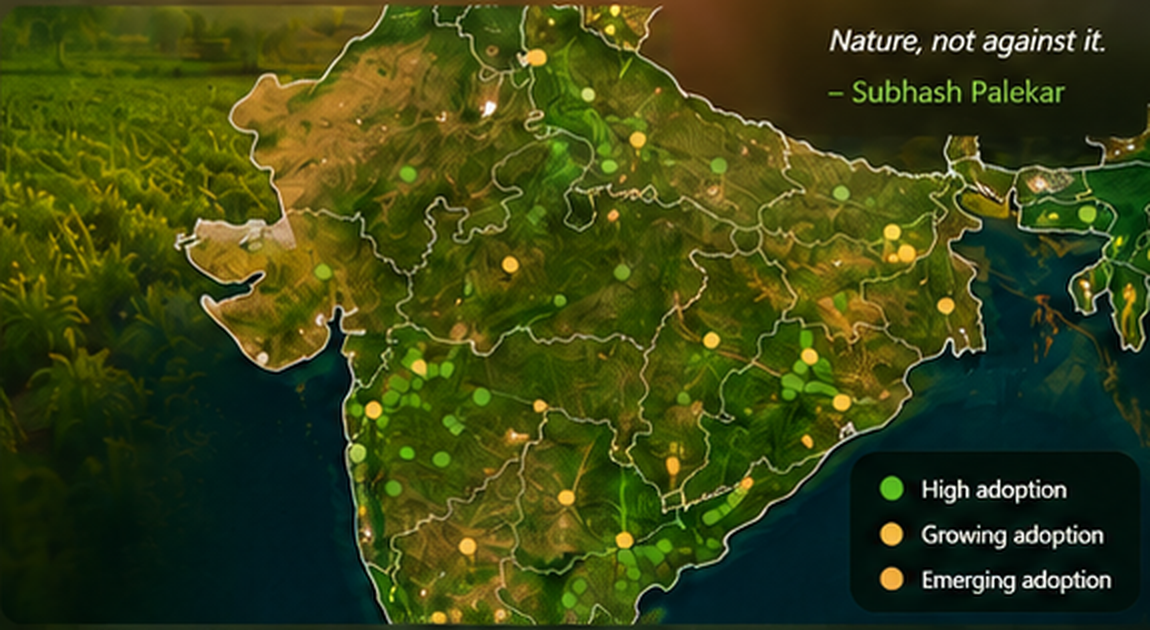
A holistic, low-cost, chemical-free farming system that packages regenerative agriculture practices into a repeatable method for Indian farmers.
Responsible innovation
Case evidence, redesigned
Lower input costs, less chemical dependency, stronger net income potential, and reduced exposure to input price volatility.
Healthier food systems with lower chemical exposure and stronger trust in naturally grown produce.
Improved soil fertility, lower water demand, reduced contamination, biodiversity support, and climate resilience.
Key takeaway: The economic story is strong, but diffusion strategy must address labor burden and weak market premiums.
Key takeaway: Materials fall, while labor becomes a more visible adoption constraint.
Key takeaway: Complete SPK sharply reduces fertilizer and pesticide expenses in the case evidence.
Key takeaway: Lower water demand strengthens the environmental and climate-resilience case.
Key takeaway: Consumer health is part of SPK’s broader responsible-innovation value proposition.
Diffusion engine
Consulting diagnosis
Our analysis suggests the primary obstacle is not the farming methodology itself. It is the perceived risk of transition inside an agricultural system still optimized for conventional chemical farming.
Strategic recommendations
The proposal is not simply to promote SPK harder. It is to make adoption safer, more trusted, more visible, more rewarded, and more evidence-based.
Farmers fear uncertainty during the transition.
Transition incentives, crop insurance, and low-interest financing.
Farmers trust established government systems.
Extension services, university partnerships, and independent validation.
Benefits are not always observable locally.
Regional demonstration farms, farmer ambassadors, and showcase days.
SPK produce often receives no price premium.
Certification, premium branding, buyer partnerships, and consumer awareness.
Scaling requires stronger long-term validation.
Multi-year crop trials, yield studies, soil-health tracking, and economic analysis.
Position SPK not simply as an alternative farming method, but as India's flagship implementation of regenerative agriculture integrated into the broader agricultural value chain.
References
The analysis draws from the case study, innovation-diffusion theory, change-management literature, and sustainability frameworks used throughout the presentation.
Hiremath, R., Mahajan, Y., Sanjeev, M., Sharma, V., & Kapse, M. (2025). Diffusing responsible innovation: Seeding sustainability through Subhash Palekar Krushi (SPK). Sage Business Cases. https://doi.org/10.4135/9781071980286
Primary source for SPK background, case data, adoption barriers, benefits, and policy context.
Rogers, E. M. (2003). Diffusion of innovations (5th ed.). Free Press.
Supports the diffusion-engine page, including adoption stages, communication channels, observability, and trialability.
Szamosi, L. T., & Duxbury, L. (2006). Development of a model of resistance to change: What does the literature tell us? The International Journal of Knowledge, Culture and Change Management: Annual Review, 5(1), 21–30. https://doi.org/10.18848/1447-9524/CGP/v05i01/49441
Supports the resistance diagnosis and the broader discussion of why beneficial change still faces adoption barriers.
Umbrex. (2026, June 19). Maurer Three Levels of Resistance Model | Change Management. Independent Management Consultants. https://umbrex.com/resources/frameworks/organization-frameworks/maurer-three-levels-of-resistance-model/
Supports the Knowledge Gap, Risk Gap, and Trust Gap framing used on the Resistance page.
United Nations. (n.d.). Sustainable Development Goals. https://sdgs.un.org/goals
Supports the responsible-innovation framing and the discussion of SPK's relationship to poverty, health, climate, production, and land stewardship goals.
References are grouped by how they support the consulting narrative: case evidence, innovation diffusion, resistance to change, and sustainability impact.
AI Disclosure
Artificial intelligence was used as a creative production and presentation-development tool. It supported the website experience, visual direction, and presentation polish; the team retained responsibility for analysis, recommendations, and final decisions.
Interactive website architecture, user interface concepts, HTML/CSS/JavaScript implementation support, navigation behavior, animations, and responsive layout refinement.
Visual concept generation, farming-themed artwork direction, infographic styling, icon selection, page composition, and cohesive presentation aesthetics.
Presentation flow, page organization, content formatting, speaker-facing polish, copy editing, proofreading, and delivery refinement.
Background music was AI generated and integrated into the website as a looping presentation soundtrack to support atmosphere, pacing, and immersion.
AI assisted with production, design, presentation refinement, and generation of the background music. Analytical conclusions, strategic recommendations, and final project decisions represent the independent judgment of the project team.
Guided presentation ready
This experience includes guided narration, a continuous looping soundtrack, and automatic page transitions. You can turn guided presentation off at any time and navigate freely.
Audio requires one click to start in modern browsers.